Therapy for Kids with Autism
Watch as Hopebridge experts break down the diagnosis of autism and why ABA therapy is so effective in treating these kiddos.
Simply put, Applied Behavior Analysis (ABA Therapy) is a scientific, behavioral management approach. Let Hopebridge help you find answers today!

If your child has autism or if there is a concern they might have autism, you’ve likely heard about Applied Behavior Analysis from your pediatrician. Or another parent told you how much it helped her son or daughter in the years leading up to school. Maybe you read about it online. But what does ABA look like and how does it work? Chances are, you still feel you’re lacking details on what it means for your child, and we’re here to show you its life-changing power.
Simply put, Applied Behavior Analysis is a scientific, behavioral management approach. By utilizing basic principles of behavior, special techniques and positive reinforcement, ABA therapy can bring about significant, measurable change. It’s a way to shape and mold actions for effective communication and learning. It has been proven to improve attention, focus, social skills and memory, as well as decrease behaviors such as noncompliance, aggression, self-injury and stereotypy. ABA methods help kiddos replace hindering behaviors so they learn “what to do,” not just “what not to do.”
ABA is a structured, data-driven way to change behavior by looking at what is reinforcing it. Behavior that is reinforced tends to be repeated, and behavior that is not reinforced will disappear. The practice concentrates on antecedents (environmental situations that occur before the behavior) and consequences.
People often believe “consequence” is a negative term, but instead, think about it as what happens after a behavior. In ABA, we focus on the positive side of this principle to teach new skills and minimize other actions. One technique starts with a prompt, and when therapists get the responses they are looking for, they introduce a reinforcer to let the kids know it’s a good thing they want to see again…a high five, toy, snack or some other kind of praise.
Using ABA to teach consists of breaking down activities into smaller pieces in order to tackle larger goals. It may take a little longer for kids with autism to learn certain tasks that come naturally to others because their minds work in a different way. Our goal is to make sure we give them the attention and means to the same opportunities so they can reach their own goals.
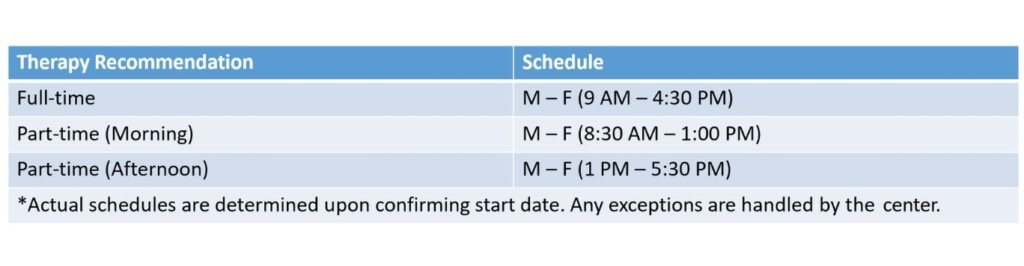
We focus on early intensive behavioral intervention (EIBI), which is traditionally geared toward children ages 18 months to 7 years, though we can tailor programs for kids as young as 15 months and up to age 12. Evidence shows consistent and comprehensive therapy for 20 to 40 hours over five days per week yields the best clinical outcomes. Hopebridge specializes in providing clinical recommendations and therapy for children who meet the criteria for both full- and part-time schedules. Here is what a schedule might look like for your kiddo:
Thankfully in today’s world there are more options than ever for individuals with autism. At Hopebridge, we choose to focus on ABA therapy because it is an evidence-based, “best” practice treatment.
It is endorsed by the U.S. Surgeon General, the National Institutes of Health, the American Academy of Pediatrics and the American Psychological Association…we take that pretty seriously! Not only has it passed scientific tests of its usefulness, quality and effectiveness, but we’ve seen it change lives, first hand.
We encourage you to do your research to find what works best for your family. You are welcome to join us for a tour and conversation to learn more about what center-based ABA therapy and our Hopebridge360 model have to offer.
Children on the autism spectrum are capable of learning the same skills as neurotypical children; they just need to use different strategies to get there. Hopebridge focuses on teaching kids the way they learn rather than trying to fit them into some kind of mold, which unfortunately many experience if they attend school without first receiving behavioral therapy. One of the great things about ABA is that its span and scope are broad and encompass multiple areas. In combination with other complementing therapies, skills that can be taught through principles of ABA include (but are not limited to):