Get to Know Hopebridge’s Speech Pathologists in North Carolina
January 23, 2026
January 23, 2026
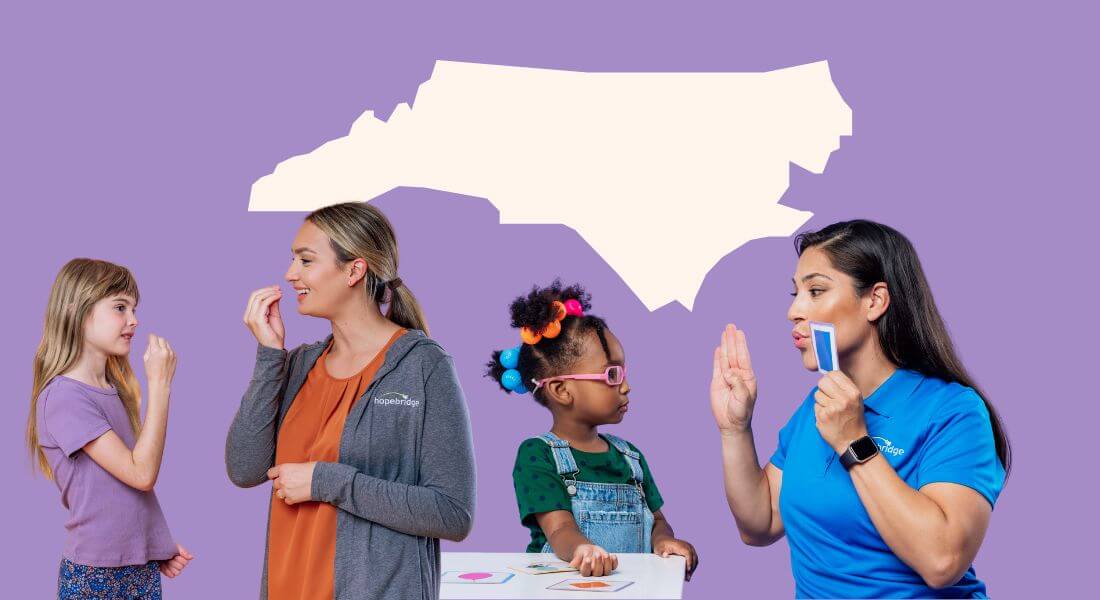
A child’s first words, gestures and attempts to communicate are powerful milestones, but when those skills don’t develop as expected, caregivers often have questions like, “Is my kid just a late talker, or could speech therapy help?” or “Is this picky eating in kids normal for their age?”
For families across North Carolina, access to pediatric speech-language pathologists and early intervention services is expanding, making it easier to find answers and support sooner.
Hopebridge now offers pediatric speech therapy in North Carolina, alongside occupational therapy, at local clinics throughout the state. These services are designed to support infants, toddlers and preschoolers during the most important years for language development, learning and social interactions.
Speech therapy for children focuses on helping kids build essential communication skills, including understanding language, expressing wants and needs, producing speech sounds clearly, and developing early social communication. A licensed speech-language pathologist (SLP) can support children with speech delays, language disorders, feeding challenges and communication differences related to autism spectrum disorder (ASD). Early speech therapy can play a key role in school readiness, social connection and confidence—both in and out of the classroom.
For families navigating developmental delays or autism, Hopebridge may also offer applied behavior analysis (ABA therapy), allowing children to receive coordinated care from a multidisciplinary team, all under one roof.
To share what pediatric therapy looks like in action, we spoke with several of our North Carolina speech therapists. They share how early speech therapy support young children, what inspires them in their work, and the meaningful progress they’re already seeing in the families they serve.
Hometown: Winston-Salem, NC
Alma mater: East Carolina University (undergraduate) and North Carolina Central University (graduate)
What inspired you to pursue a career in speech therapy?
Witnessing first-hand the impact of speech-league pathology with my grandfather and receiving speech services myself as a child. I have always had a passion for caring for others and working with children.
As a pediatric SLP, what is your area of passion?
As a pediatric SLP, my area of passion is augmentative and alternative communication (AAC) and pediatric feeding.
What is it that you enjoy most about working at Hopebridge?
I love the close-knit community here at Hopebridge and how helpful everyone is!
What is your favorite activity to do with your kids during a session?
My favorite activity to do with my kids is holiday crafts and pushing into group activities to target social communication.
Tell us about a moment or case that made you think, “This is why I do what I do.”
When my kiddos greet me verbally and identify me with their AAC devices. “Hey, Miss Grace!” is my favorite thing to hear!
What is a fun fact about you that your coworkers and kids may not know?
I received speech-language pathology services when I was 1-2 years old.
Hometown: Richardson, TX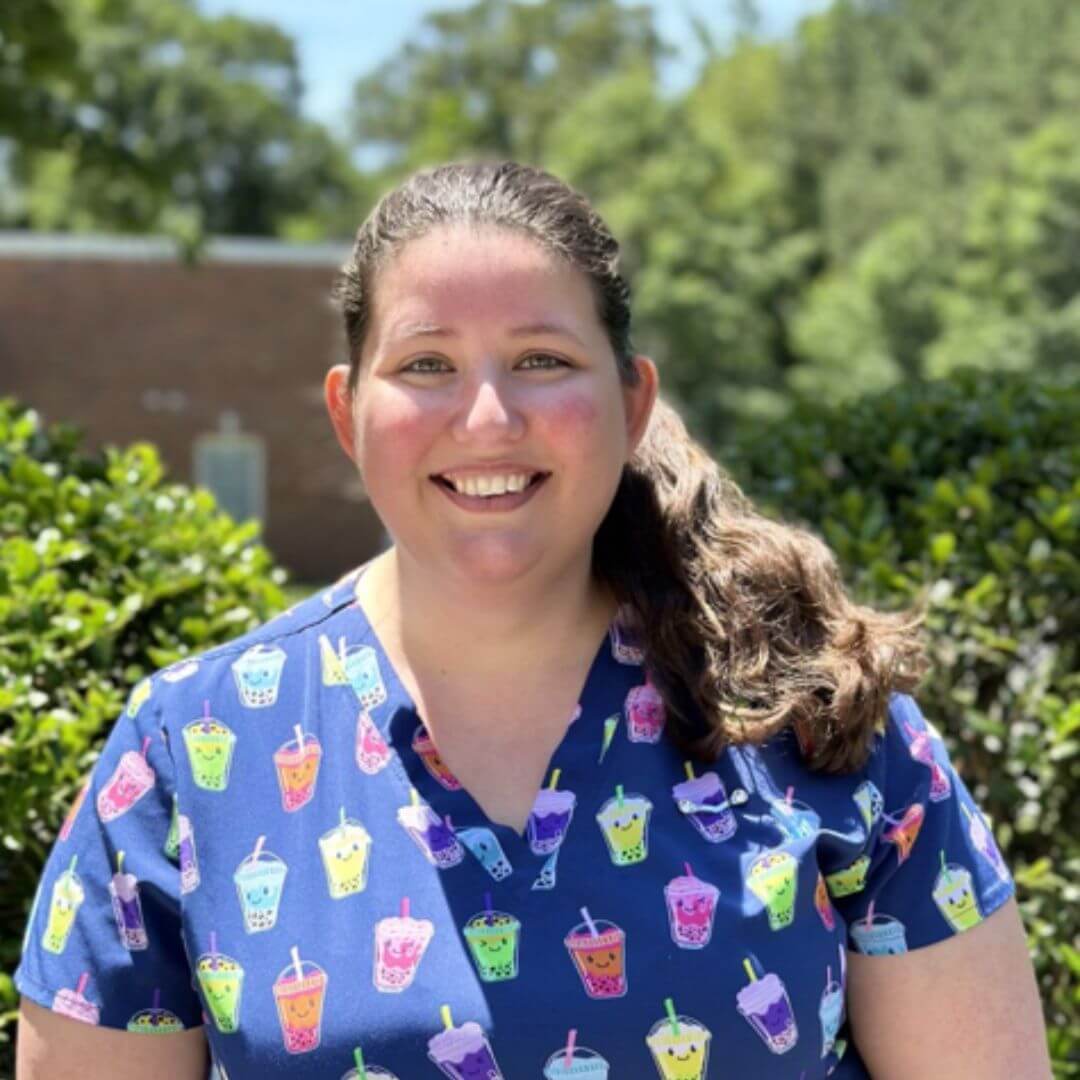
Alma mater: University of Texas at Arlington (B.S. Psychology) and University of North Texas (M.S. Speech-Language Pathology)
What inspired you to pursue a career in speech therapy?
I grew up saying that I wanted to help people and play with kids all day. As I got older, I was happy to discover speech-language pathology (SLP) as a dynamic career where I get to help people – children, specifically – all the time and still play with kids all day.
As a pediatric SLP, what is your area of passion?
The populations I enjoy working with are children with severe/profound developmental/intellectual disabilities and children diagnosed with autism spectrum disorder (ASD). AAC and feeding are my favorite areas to help children achieve their fullest potential.
What is it that you enjoy most about working at Hopebridge?
My favorite thing about working at Hopebridge is being able to collaborate with all disciplines. I can always ask questions and I love being able to provide input and educate other professionals when they seek my assistance.
What is your favorite activity to do with your kids during a session?
My favorite activities involve intentionally setting up moments where something isn’t quite right. This lets me create a situation where a kiddo has to communicate with me what is wrong with the situation. I might pretend I’m unsure how an activity is supposed to go and do it incorrectly so they can correct me. I love seeing their reactions when they realize they get to be the expert and help show me the right way.
Tell us about a moment or case that made you think, “This is why I do what I do.”
I was working on teaching sign language to a patient. We were working on using, “I want” + one activity or object to request at the time. She had learned many signs. One day, she was in a common area and saw me. I think she thought I’d be able to get her something because she got my attention and stated a long sentence, “I want play piano, please,” which was two more words than we had been working on. I guess she really wanted that toy, so she used all her words! That was a very proud moment for me.
What is a fun fact about you that your coworkers and kids may not know?
I am the guild leader of a World of Warcraft Classic Progression guild, coordinating weekly events with 25-40+ people.
When a child needs support with communication, understanding language, or being understood by others, speech therapy for kids can be a powerful step forward. Working with a licensed speech-language pathologist helps children strengthen speech, language and communication skills that support success at home, in school and beyond. It’s why many families begin their search online for “speech therapy near me” when questions first arise.
At Hopebridge Autism Therapy Centers in North Carolina, families can now access speech therapy, occupational therapy, and ABA therapy in one coordinated setting. This collaborative approach supports children with autism, speech delays, speech regression, feeding challenges, and developmental differences and disorders like childhood apraxia, while giving families a clear, connected path through the early intervention process. From speech therapy for toddlers learning their first words, to preschoolers strengthening expressive and receptive language skills, to services that support older children and teens with higher-level communication skills, our team is here to help.
If you’re wondering when to start speech therapy in North Carolina or searching for a “speech therapist near me,” earlier support can lead to stronger outcomes. Take the next step by visiting hopebridge.com/contact to connect with our team and schedule a speech and language evaluation.
*Informed consent was obtained from the participants in this article. This information should not be captured and reused without express permission from Hopebridge, LLC. Testimonials are solicited as part of an open casting call process for testimonials from former client caregivers. Hopebridge does not permit clinical employees to solicit or use testimonials about therapeutic services received from current clients (Ethics Code for Behavior Analysts 5.07-5.08; BACB, 2020). Hopebridge does not provide any incentives, compensation, or renumeration for testimonials provided by a former client or client caregiver.
Team Spotlight
March 05, 2019
Haley Hatfield - Decade of Occupational Therapy at Hopebridge
Hopebridge in the News
February 01, 2026
Hopebridge Appoints Clinical Advisory Board to Advance Autism Care and Quality
Team Spotlight
April 13, 2022
“This is My Why”: Growing From RBT to Center Manager, Allison McGarry Makes an Impact Through Autism Therapy