Childhood Apraxia of Speech: What It Is and What It Isn’t
September 30, 2026
September 30, 2026
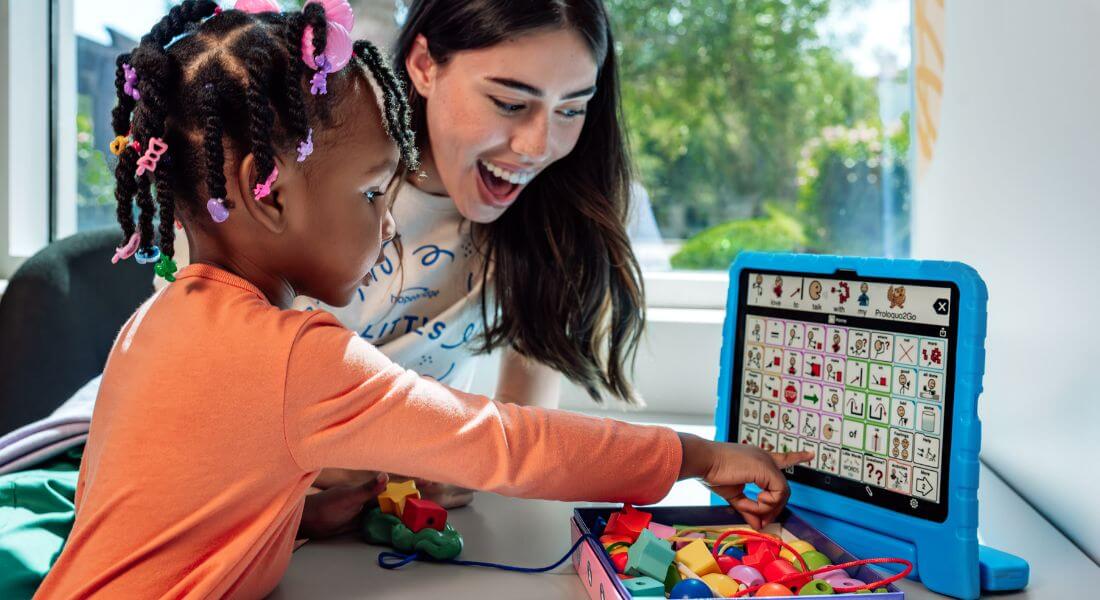
A child may have plenty to say. They may point, gesture, bring you exactly what they want or even try the same word several times, but when they attempt to speak, the word doesn’t always come out the same way.
For families, these moments can be sweet but also confusing, at times. You may wonder, “Is it a speech delay? Are they having trouble articulating? Or could something else be happening?”
When a child knows what they want to communicate but has difficulty planning the movements needed to say it, childhood apraxia of speech (CAS) may be one possibility.
CAS is a motor-planning speech disorder that affects how the brain plans and sequences the movements needed for speech. It is not cause by a lack of effort, intelligence, nor motivation. Understanding that distinction can change the way families, teachers and therapists respond to a child who is struggling to be understood.
To better understand CAS and what families should know about it, we spoke with Hopebridge Speech-Language Pathologist (SLP) Nicole Cook.
Speaking requires the brain to coordinate many movements involving the lips, tongue, jaw and other parts of the mouth. Childhood apraxia of speech is a neurological motor-planning disorder that can feel like a communication barrier.

Childhood apraxia of speech is a motor-planning disorder that affects how the brain plans and sequences the movements needed for speech.
“Children know what they want to say, but their brain has difficulty planning and coordinating the movements needed for clear, consistent speech,” said Nicole. “It’s not about effort or intelligence—it’s about the brain-to-mouth connection.”
This can make speech challenging to understand, especially as words become longer or more complex.
CAS can look different from child to child. Some children may have relatively mild inconsistencies in their speech, while others may have significant difficulty producing sounds, imitating words or sequencing movements.
Apraxia may also occur alongside other speech, language or developmental differences.
In many cases, the specific cause of CAS is unknown. However, researchers and clinicians understand that it is not caused by parenting, behavior or a child simply not trying hard enough.
That distinction matters because the way adults respond to a child’s communication attempts can influence their experience. When a child struggles to get words out, providing appropriate support can reduce frustration and create more opportunities to communicate.
One of the most noticeable characteristics of CAS is inconsistency. A child might say a word one way one time and differently the next. They may be able to produce a sound or word in one situation but struggle to produce it again.
Families may notice:
Parents sometimes describe the experience simply: “They know what they want to say, but it just won’t come out.”
That observation can be an important reason to seek a speech-language evaluation.
Because CAS can look different from other speech and communication challenges, misconceptions are common.
CAS is not:
There isn’t a single test that can determine whether a child has CAS. A comprehensive evaluation with a licensed speech-language pathologist is an important part of the diagnostic process.
SLPs may look at several aspects of a child’s speech, such as how consistently they produce sounds and words, their ability to imitate sounds, and how they respond to different types of cues.
At Hopebridge, clinicians may use dynamic assessment, which looks not only at what a child can do independently but also at how their speech changes when an SLP provides different types of support.
A speech evaluation can also help differentiate CAS from other speech and language disorders that may have similar characteristics, including phonological disorders, dysarthria and expressive language delays.
Because CAS involves motor planning, treatment typically focuses on motor-based speech therapy rather than simply teaching a child which sounds to make.

Speech therapy can help with the challenges associated with childhood apraxia of speech (CAS).
An SLP may use approaches such as:
Treatment is individualized based on a child’s communication needs and current abilities.
For example, a therapist may select a small group of meaningful words for a child to practice repeatedly to build motor pathways. The SLP might slow the word down, break it into smaller parts or use a visual or tactile cue to help the child coordinate the movements.
The goal isn’t simply to have a child repeat a word more times. It’s to help their brain learn and coordinate the movement patterns needed to produce speech.
Sometimes, children with CAS may need additional ways to communicate while their spoken language develops. Augmentative and alternative communication (AAC) may include picture-based communication, gestures, communication boards or speech-generating devices. AAC can give an individual a reliable way to express wants, needs, ideas and feelings when spoken communication is difficult.
Importantly, using AAC does not prevent or stop speech development. For some children, it can reduce frustration and give them more opportunities to participate and communicate while they continue working on speech.
A CAS diagnosis does not determine how much a child will learn, what they will understand or what they will be able to accomplish.
With consistent, individualized intervention, children with CAS can make meaningful progress toward clearer and more functional communication. The amount and pace of progress will look different for every child.
Without appropriate support, increasing language demands can make communication more challenging over time. A child may experience ongoing difficulty being understood, frustration when trying to communicate or challenges participating in social and academic activities.
Early identification and intervention can provide children with tools to communicate while building the speech skills they need.
Nicole recalls working with a young child who had limited speech and often became frustrated when trying to communicate. Their words sounded different from one attempt to the next, and moving between sounds was particularly difficult.
As part of their sessions, she and the child began using DTTC with a small set of functional words. Through repeated practice and visual and tactile cues, the child’s speech became more consistent over several months.
The most meaningful change wasn’t simply how the child sounded.
“Their confidence grew and they began using new words spontaneously. The biggest change was seeing this child initiate communication without hesitation—their personality finally had room to shine,” said Nicole.
Childhood apraxia of speech can make it difficult for children to turn the words they have in their minds into spoken language. But difficulty speaking clearly doesn’t mean a child has less to say.
If your child is difficult to understand, has trouble imitating sounds or words, uses inconsistent pronunciations or seems to know what they want to say but has a hard time getting the words out, consider talking with a speech-language pathologist.
These signs don’t automatically mean a child has CAS. Several speech and language conditions can present in similar ways, which is why a comprehensive evaluation is important. An SLP can help determine what may be contributing to your child’s communication challenges and recommend strategies and services based on their individual needs.
The right support can give children more ways to express themselves while helping them develop the motor skills needed for speech.
*Informed consent was obtained from the participants in this article. This information should not be captured and reused without express permission from Hopebridge, LLC. Testimonials are solicited as part of an open casting call process for testimonials from former client caregivers. Hopebridge does not permit clinical employees to solicit or use testimonials about therapeutic services received from current clients (Ethics Code for Behavior Analysts 5.07-5.08; BACB, 2020). Hopebridge does not provide any incentives, compensation, or renumeration for testimonials provided by a former client or client caregiver.
Autism Therapy
April 26, 2022
Time for an Occupational Therapy Evaluation? Here’s What to Expect
Hopebridge in the News
June 18, 2019
Hopebridge Autism Therapy Centers Expand Into Fishers and Columbus, Indiana
Parenting Resources
July 24, 2018
Life After Loss: A Father’s Open Letter to Autism Families