First-Year BCBA Shares Hopebridge’s Support for Career Growth
August 28, 2026
August 28, 2026
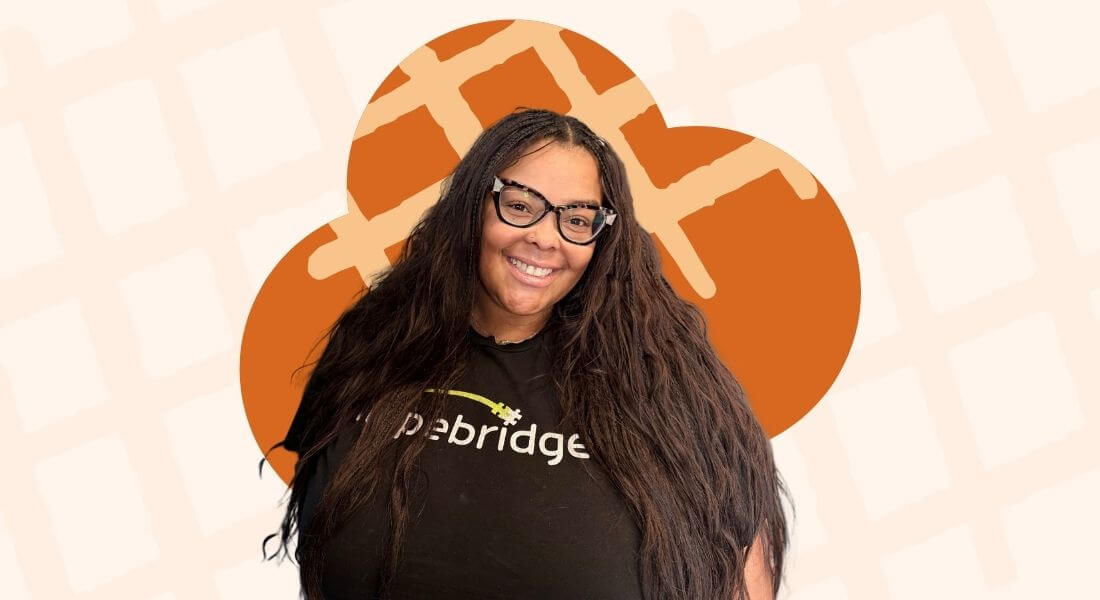
For many aspiring BCBAs, the path from graduate school to clinical practice can feel like a big leap. For Noelle Robinson, that journey has unfolded one step at a time: from RBT to Fellow to Case Manager and, now, a first-year BCBA at Hopebridge therapy center in Munster, IN.
Noelle has experienced several stages of the clinical career path firsthand. And while each role has brought new responsibilities, one thing has remained consistent: the importance of having opportunities to learn, ask questions and grow with support.
“As someone who walked into the role still fresh in the science of ABA, I gravitated toward Hopebridge because it’s an organization focused on learning,” said Noelle.
Noelle’s interest in applied behavior analysis (ABA) began while she was in college. Originally studying to be a speech-language pathologist, an experience supporting other students with autism spectrum disorder (ASD) led her to explore the field more closely. She eventually changed her major and joined Hopebridge, earning her Registered Behavior Technician (RBT) certification through the organization.
Noelle briefly continued her career at another clinic in her Illinois hometown after first working at Hopebridge. Though she values what she learned during that time, she was in graduate school to become a board certified behavior analyst (BCBA) and was drawn back to Hopebridge by the structure of its Fellowship Program.
For Noelle, the Fellowship provided something that complemented the foundational knowledge she gained in graduate school: hands-on preparation for the realities of being a BCBA.
“Grad school gave me that foundational knowledge, but I wanted to be the most well-rounded BCBA possible,” said Noelle. “I learned about the science, but I didn’t really understand how to be a BCBA until I got into the Fellowship Program.”
She appreciated how the program broke the many responsibilities of a BCBA into smaller, more manageable pieces while bridging the gap between coursework, fieldwork and independent clinical practice.
“It’s the most structured program I’ve seen of its kind. The Fellowship Program helped me understand how to actually work as a BCBA. I had the opportunity to take the things I learned from studying and fieldwork experience, and apply them in real time,” said Noelle.
Passing the BCBA Exam® marks an important milestone. It was the beginning of a new phase, but for Noelle, it wasn’t the end of her learning.
“You’re a BCBA, what now?” she remembers asking herself.
The transition from Case Manager to BCBA brought new levels of clinical autonomy and responsibility. Noelle describes experiencing some “imposter syndrome” as she adjusted to making clinical decisions independently.
“It took me about two or three months to realize, ‘Ok, Noelle, you are in it. You are able to make these clinically sound decisions,’” said Noelle.
It was Hopebridge’s Bridge Program that helped ease this transition by providing support beyond direct supervision and program modification. Noelle says the program helped her better understand the many responsibilities that come with being a clinician, including areas where she initially lacked confidence.
Mentorship was another important part of that support. As part of the Bridge Program, she was paired with another clinician she could turn to during her first few months as a BCBA. This mentor guided her through new responsibilities and the boundaries that came with her role.
And when questions arise, Noelle knows she has a vast and varied clinical team she can rely on for support. At the Munster center, she collaborates with experienced BCBAs and her Assistant Clinical Director, who provide guidance throughout challenges and clinical decisions.
Noelle’s development as a clinician also happens through collaboration with professionals across disciplines. She views interdisciplinary collaboration as another opportunity to learn while bringing different areas of clinical expertise together to support children and families.
At Hopebridge, the 360 Care model brings together professionals across ABA, speech and occupational therapy, allowing clinicians to share perspectives and align their expertise around each child’s individual goals.
That model is especially meaningful to Noelle as her Munster center recently began offering speech therapy. With her own early interest in speech pathology, she is excited about the opportunity to better understand how communication-focused expertise can complement ABA.
“It’s exciting to have a bit of knowledge into the science of communication and understanding how we can bridge the gap and come together for the best care for our patients,” said Noelle.
That same collaborative mindset has helped her grow in Family Guidance, too. Clinical support and open communication have helped her build confidence when coaching caregivers through these sessions.
Noelle’s career path has also now come full circle. One of her RBT supervisees was recently accepted into the Hopebridge Fellowship Program—the same program that helped Noelle prepare for her own BCBA career.
Because Noelle has experienced the progression herself, she can offer her supervisees a perspective that goes beyond career advice. She understands what it feels like to be an RBT considering the next step, a graduate student completing fieldwork, and a new BCBA learning to trust her own clinical judgment.
For Noelle, professional growth ultimately connects back to the children and families she serves, but as she approaches the completion of her first year as a BCBA, Noelle knows her own development will continue, too.
“Growing into this role, most students were so focused on passing the exam and getting our hours—but students don’t often consider what it will look like within the first six months as a BCBA.” said Noelle. “I am grateful that the Fellowship Program and Bridge Program prepared me for that experience.”
She told us she encourages RBTs and other budding BCBAs, as well as more experienced clinicians, to look into the programs and development opportunities Hopebridge offers.
“I love that Hopebridge is ever-evolving and changing according to the needs of the people that it serves—both families and clinicians,” said Noelle.
If you’re an ABA graduate student or BCBA looking to advance your career, Hopebridge also offers everything from mentorship programs and free continuing education (CE) opportunities to travel BCBA positions and a BCBA Career Pathway.
*Informed consent was obtained from the participants in this article. This information should not be captured and reused without express permission from Hopebridge, LLC. Testimonials are solicited as part of an open casting call process for testimonials from former client caregivers. Hopebridge does not permit clinical employees to solicit or use testimonials about therapeutic services received from current clients (Ethics Code for Behavior Analysts 5.07-5.08; BACB, 2020). Hopebridge does not provide any incentives, compensation, or renumeration for testimonials provided by a former client or client caregiver.
Hopebridge in the News
February 01, 2026
Hopebridge Appoints Clinical Advisory Board to Advance Autism Care and Quality
Team Spotlight
January 23, 2026
Get to Know Hopebridge’s Speech Pathologists in North Carolina
Team Spotlight
August 19, 2025
Get to Know Hopebridge’s Pediatric Occupational Therapists in North Carolina
Team Spotlight
August 10, 2023
Senior and Lead BCBAs Find Growth in New Roles with Hopebridge BCBA Career Pathway